Showing posts with label Buddha. Show all posts

Friday, February 17, 2012

Buddhist Religious Architecture: The Stupa


Examples of Stupas:


Second Quiz: Buddha & Shiva

Seated Buddha from Gandhara (Victoria & Albert Museum)

Choose either one of the images here and, in separate paragraphs, describe any three individual symbolic details and their meaning, and then conclude with a paragraph that describes how these three details fit together as parts of  the object's overall meaning. (For those of you counting, that makes four paragraphs.) Quizzes are due & will be collected in class next Wednesday, February 22nd.

Things that matter: a) accuracy of information b) the depth of thought & understanding present in your answer and c) clear and correct language that avoids any hint of plagiarism -- including paraphrasing a source without citation.

Shiva Nataraja (Cleveland Museum of Art)

Thursday, February 9, 2012

Buddhas Again -- from Thailand


The Sukhothai period (14th century) was especially important for Buddhist art in Thailand, as during this time a distinctive stylistic approach was formulated. Buddha's in this style. These Buddhas have all the standard iconography associated with Buddhas elsewhere, but emphasize long, graceful, curvilinear forms. Although some are seated, or reclining, others show the Buddha standing or walking.

Wikipedia article: Buddha Images in Thailand
Thai Buddhist Art and Architecture at the UC Riverside Thai Digital Monastery Project
A Mon Period Buddha (6th-8th century) at the Asia Society


tdm.ucr.edu

artsmia.org

Tuesday, February 7, 2012

Buddhas beyond India


Buddha (Thailand, 14th c.)
 
Buddha (Korea, AD 900-1100)
OK, so we've looked at early representations of the Buddha (from Gandhara) and we've looked at a later example (from Sarnath) which shows the early form refined into a classic formula.  Now it's time to consider how that classic formula gets taken up & refined by different cultures, outside India.  

We should keep in mind that, while the Buddha is in some sense a representation of an abstract ideal, the Buddha is also a specific material subject.  In Africa we looked at how different cultures portrayed similar abstract ideals (kingship, power, the relationship between men and women, the ideal child) but always through subject matter that varied from specific culture to specific culture.  The Buddha is a subject matter than can "belong" to any people.  The Buddha crosses all boundaries.   

The Buddha is not just art from the world; the Buddha is art of the world.  There are many peoples, many forms of Buddhas, many styles of Buddhas, many Buddhas, but at the same time, all Buddhas are one.

Article on "Buddhism and Buddhist Art" at the Metropolitan Museum of Art
Article on "The Art of Buddhism" at the Smithsonian Institution
Some different examples of Buddhas
A Chinese Buddha (late 7th-early 8th century)
Another Chinese Buddha (7th century)
A Tibetan Seated Buddha (9th-10th century)
A Buddha from China (early 11th century)
A Buddha from Thailand (16th century)
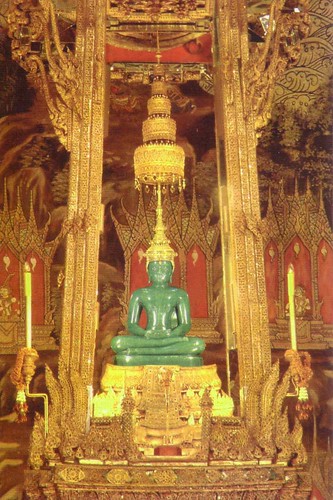
The Emerald Buddha in Bangkok
A Sukhothai Walking Buddha
Many Buddhas in Baltimore
Perfection in the proportions of a Buddha (BuddhaNet)


Friday, February 3, 2012

More Buddha Basics: typical features & Gupta style


Teaching Buddha at Sarnath (1-13)

Gupta Period Sculpture

Note the lakshanas seen here:
- the urna or dot between the eyebrows
- the ushnisha or cranial bump
- the mudra or hand position (here, teaching the wheel of dharma)
- elongated ears
- simple monk's robe
- the asana or posture (here, meditating)
- lotus seat (here the folds of his robe & not an actual lotus)
- wheel symbols on feet
- halo behind the head


Other Resources:

Thursday, February 2, 2012

Buddha Basics & Gandhara style


Basic Buddhism Guide from BuddhaNet 
Buddhism and Buddhist Art essay at the TOAH
The Art of Buddhism (Freer & Sackler Gallery Guide -- several pages)

Life of the Buddha essay at the TOAH
BuddhaNet article about the Buddha’s First Sermon at Sarnath
Article on Greco-Buddhist art at Wikipedia
Gandhara period frieze of the First Sermon at the Met